
We are now turning our attention to the 20th Century revolutions in physics that realized Newton’s dream. In today’s post I want to talk a bit about physics before the revolution. This will provide the context from which we are starting and will allow us to see more precisely what the new ideas changed.
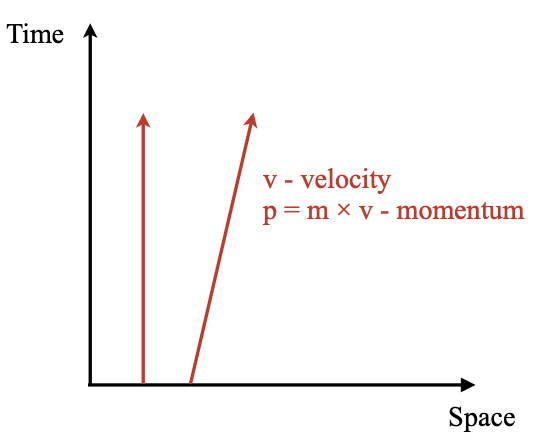
I will use simple diagrams to describe things happening in the world. These diagrams will have space going on the x-axis and time moving along the y-axis; they can describe motion in 1D. For example, a particle or some other object that wasn’t moving in time would be described by a straight vertical line. Whereas something that is moving would be tilted; it changes its spatial position as time moves forward. If the line is straight, we say that the particle has a constant speed or velocity v. Another useful concept associated with this notion of velocity is momentum. If the particle that is moving has a certain mass m, then its momentum is given by p=mv.
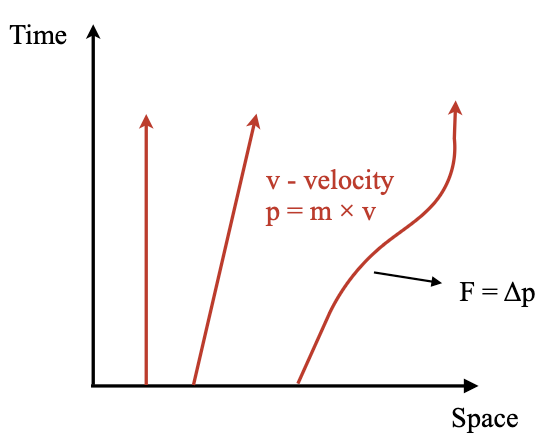
One of the things that Newton taught us is that things can also move in curved lines. You can change your velocity, and when there is a change there is an associated force responsible for the change. His work in the Principia laid these foundations.
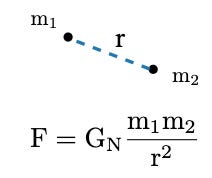
Not only did Newton tell us how the lines change, he also gave examples of the forces. For example, the force of gravity. If you have two objects with mass separated by a distance r, there is a force between them that you can calculate, given in the equation below.
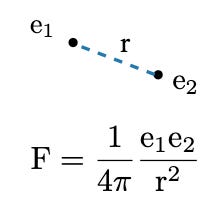
Since then we have learned that there are other forces, which we now know how to calculate. One example is the electromagnetic force. If two objects have electric charge, there is another force associated with them that is given by a force law that looks similar to Newton’s Gravitational interaction:
So Newton not only taught us how particles move in response to forces, he also taught us how to calculate what the forces are. Again, this is all before the revolution.
A few general comments about this picture of the world. Everything that will happen in the future (or did happen in the past) is encoded in the present. If you know where all the particles are, you can calculate all the forces. If you know how the particles are moving and all the forces you can then to predict where they will be and how they will be moving at the next instant. The world described by this physics is deterministic. The current state of the world plus the laws of physics fixes the next state of the world.
Scientists, and even Newton himself, were not happy about the form of the forces in Newton’s physics. The forces we looked at above are defined and have non-zero values, regardless of how far apart the particles are. If you move one of them, the force on the other one instantly changes without some kind of intermediate messenger. There is action at a distance. All particles somehow know where all the other particles are, even if they are arbitrarily far away.
A final point, with similar implications, is that in Newton’s physics there is no limit to how fast particles can move. This means that particles that are arbitrarily far away, if they are moving sufficiently fast, can affect what happens here in the next instant. So what happens next, in an arbitrarily small time step, depends on the motion and position of all the particles, even those arbitrarily far away. There is an inherent “non-locality” to events in space and time. What happens next, right here, depends on everything happening right now, not just what is happening in our local neighborhood.
This was the conception of what physics was before the revolutions. We will pick up next time on the first revolution: the principle of relativity.